How to Write a Contract That Protects Your Business
Learn how to write a contract with our practical guide. We cover essential clauses, clear language, and negotiation to create legally sound agreements.


Tired of nonsense pricing of DocuSign?
Start taking digital signatures with BoloSign and save money.
Before you write a single word of a contract, the real work begins. It’s all about gathering the critical information upfront to make sure the final document is clear, enforceable, and actually protects everyone involved. Rushing this stage is the number one cause of disputes down the road.
Laying the Groundwork for a Solid Agreement
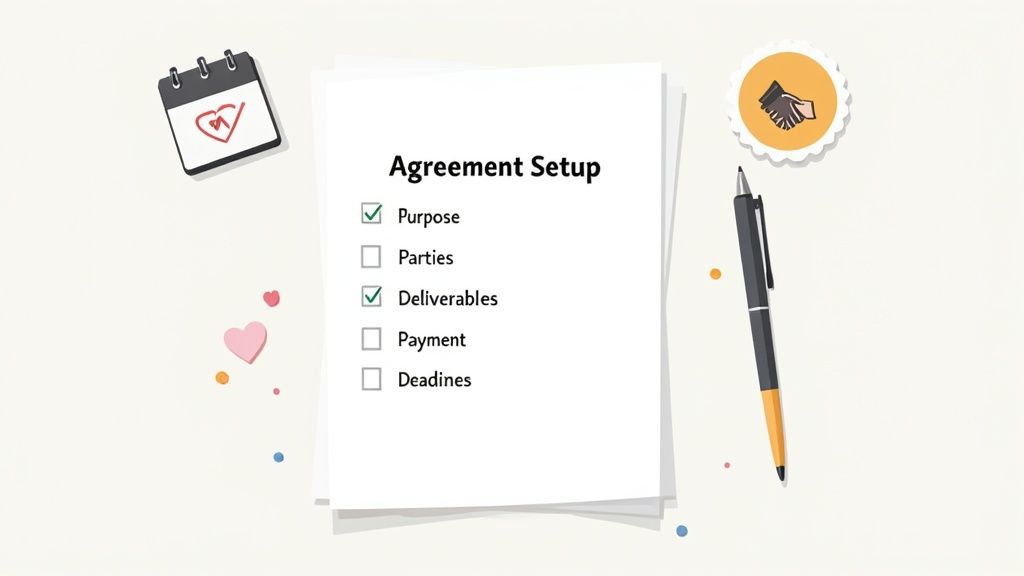
Think of contract planning as building the foundation for a house. A solid plan leads to a strong agreement that stands up to scrutiny; a rushed one invites ambiguous terms, missed obligations, and painful revisions later. You’re not just filling out a template—you're building a framework for a business relationship.
The very first thing to nail down is the agreement's core purpose. What, exactly, are you trying to accomplish? Is it a real estate agency formalizing a property sale? A healthcare clinic defining patient service terms? Or a logistics firm locking in a shipping arrangement? A crystal-clear objective will guide every clause you write.
For example, a staffing agency's contract with a new corporate client needs to get specific about the types of roles to fill, the target number of placements, and the exact fee structure. Getting this clarity from the start ensures both sides are on the same page from day one.
Identifying the Parties and Their Roles
This sounds basic, but you’d be surprised how often people get it wrong. Incorrectly identifying the parties can render an entire agreement invalid. You need the full, correct legal names and addresses for every individual or business entity.
- For Businesses: Use the complete registered name, including suffixes like "LLC" or "Inc." Don't just use the doing-business-as name.
- For Individuals: Use their full legal name as it appears on government-issued ID.
- For Trusts or Estates: Specify the exact name of the trust and the trustee signing on its behalf.
It's just as crucial to confirm that the person signing for a company actually has the authority to do so. For a professional services firm, that might be a managing partner. In a larger corporation, it could be a department head or a procurement officer with a specific signing limit. Verifying this authority upfront prevents the contract's validity from being challenged later.
Nailing Down the Core Commercial Terms
Once you know the who and the why, it's time for the commercial heart of the agreement: the who, what, when, and how much. These terms are the engine of your contract.
A contract is only as strong as its clearest terms. Ambiguity in deliverables or payment schedules is the primary source of business disputes. Defining these specifics at the start is your best form of risk management.
Key commercial terms you absolutely must establish include:
- Deliverables: What specific goods or services will be provided? Be painfully detailed.
- Payment Schedule: How much will be paid, when are the due dates, and what are the accepted payment methods?
- Timelines and Deadlines: When does the work start and end? Are there critical milestones with their own dates?
- Scope of Work: What's included? Just as importantly, what is explicitly excluded?
For most business agreements, having a solid grasp of commercial transactions law is essential. This knowledge helps ensure your terms aren't just commercially sound but also legally enforceable.
This planning phase is also the perfect time to build in efficiency. Instead of starting from a blank page every time, using a platform like BoloSign lets you create, send, and sign PDFs from pre-built templates for common agreements. This kind of contract automation helps you capture all these essential details systematically. When you're ready to get the deal done, the transition to a secure eSignature is seamless, making the entire process faster and far more reliable.
The Essential Anatomy of an Ironclad Contract
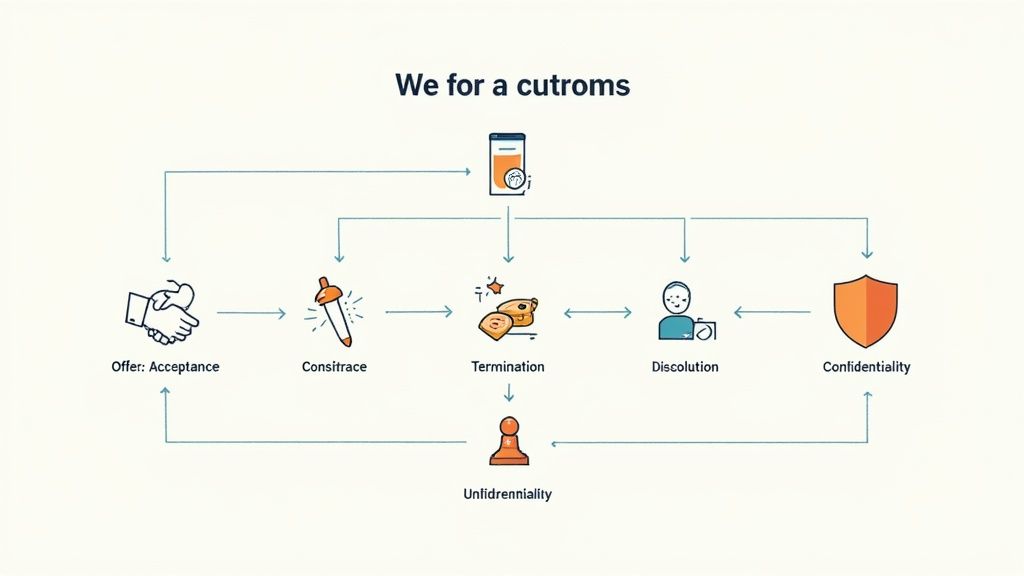
Every solid contract, whether it’s a simple freelance agreement or a complex multi-year partnership, shares a common DNA. Getting this structure right is the difference between a document that protects you and one that creates costly confusion down the road.
Forget the intimidating jargon for a moment. At its heart, a contract is just a documented promise. It starts with three simple, non-negotiable building blocks: the offer, the acceptance, and the consideration.
Think about it like this: one party makes a clear proposal (the offer). The other party agrees to it without changing the terms (the acceptance). And, crucially, both sides exchange something of value (the consideration). This value doesn't have to be cash; it can be services, goods, or even a promise not to do something.
For a procurement manager, this is second nature. They issue a purchase order (the offer) to a supplier. The supplier confirms they can fulfill it (the acceptance), and the exchange of goods for payment is the consideration. If any one of those three pieces is missing, you don't have a legally binding contract.
Core Elements That Form a Binding Agreement
To stand up in court, an agreement needs to be more than just a handshake. It must contain a few key elements that leave zero room for interpretation.
Offer and Acceptance: This is the "meeting of the minds." The offer needs to be specific, and the acceptance must be a clear, unconditional "yes." If the other party comes back with different terms, that’s not an acceptance—it’s a counteroffer, which effectively kills the original offer.
Consideration: As we touched on, this is the value exchange. In a logistics contract, the carrier’s consideration is the transportation service they provide, and the shipper's is the payment for that service. Both sides have to give something up.
Legality: The contract's purpose must be lawful. An agreement to do something illegal is void from the get-go, no matter how well it’s written.
Capacity: All parties involved must be legally capable of entering into a contract. This means they're of legal age, are of sound mind, and aren't being forced or tricked into signing.
A well-drafted contract isn't just about what's included; it's about making those inclusions incredibly clear. The goal is to create a document that a third party, like a judge, could read and understand exactly what was agreed upon without needing external context.
Protective Clauses You Should Never Overlook
Beyond the fundamentals, a truly robust contract is layered with clauses designed to manage risk and spell out what happens when things go wrong. Think of these as your business's first line of defense. The demand for expert drafting is surging for a reason; the global contract drafting service market is expected to grow by 10.4% annually through 2033, largely because businesses need help navigating complex rules and regulations. You can get a closer look at these market drivers in this detailed research on contract drafting services.
Any good contract template, like those you’d find in BoloSign, will have these critical protections baked in. This ensures your contract automation process covers the legal bases from the very beginning.
Here’s a quick look at the essential clauses that protect your interests.
Essential Contract Clauses and Their Purpose
This table breaks down some of the most common legal clauses you'll encounter. While they might seem like boilerplate, each one serves a very specific and important function in protecting your business.
| Clause Name | What It Does | Why It's Critical (Example) |
|---|---|---|
| Termination Clause | Defines how and when the contract can be ended by either party, both for cause (like a breach) and for convenience. | A healthcare clinic needs this to cleanly end a service agreement with a supplier who consistently fails to deliver medical supplies on time. |
| Dispute Resolution | Specifies the process for resolving disagreements, such as mediation, arbitration, or litigation in a specific jurisdiction. | Prevents a minor disagreement in a professional services contract from escalating into a costly and lengthy court battle. |
| Confidentiality (NDA) | Prevents one or both parties from disclosing sensitive information shared during the business relationship. | An education technology company uses this to protect its proprietary software code when working with a freelance developer. |
| Limitation of Liability | Caps the amount of damages one party can be liable for in case of a breach or negligence. | A staffing agency might cap its liability to the total fees paid under the contract, protecting it from disproportionately large claims. |
Knowing how to properly draft a limitation of liability clause is particularly vital for managing your financial exposure. You can dive deeper into the specifics by reading our comprehensive guide on limitation of liability clauses.
Ultimately, these clauses are not just legal formalities. They are strategic tools that give you control and predictability.
When you build your agreements with these core components and protective clauses, you're not just creating a document. You’re building a clear, enforceable roadmap for your business relationships—one that’s easy to manage, review, and ultimately sign off on with a secure eSignature.
Drafting with Clarity to Avoid Future Disputes
A contract choked with dense legalese and ambiguous phrasing is just a future conflict waiting to happen. The goal of drafting isn't to sound like a lawyer from a classic film; it's to create an agreement that everyone involved can read, understand, and follow without needing a translator.
Clarity is your best defense against costly disputes. It also builds stronger business relationships from day one.
This means you have to actively choose simple, direct language over complex jargon. Instead of "heretofore" or "party of the first part," just use the actual names. Swap convoluted sentences for short, declarative statements. This isn't just about making it easier to read—it's about making it enforceable.
For instance, a professional services firm creating a Statement of Work (SOW) should never settle for a vague description like "provide marketing support." A much clearer, more defensible version would be: "deliver a monthly performance report covering website traffic, lead generation by source, and social media engagement metrics by the fifth business day of the following month." Specificity leaves no room for debate.
Embracing Plain Language Principles
Writing in plain language doesn't mean dumbing down your contract. It means being precise and direct to stamp out any ambiguity. Every sentence should have a crystal-clear purpose.
Here are a few actionable principles to get you started:
- Use Active Voice: Say "The vendor will submit invoices monthly" instead of "Invoices will be submitted monthly by the vendor." Active voice assigns clear responsibility.
- Define Your Terms: If you use an industry-specific term or acronym, define it the first time it appears. Never assume everyone shares your vocabulary.
- Keep Sentences Short: Long sentences loaded with multiple clauses are a nightmare to follow. Break down complex ideas into several shorter sentences.
The most effective contracts are those that prevent disputes, not just win them. By prioritizing clarity, you reduce the likelihood of misinterpretation and create a document that serves as a practical guide for the business relationship, not just a tool for litigation.
Leveraging AI for Smarter Drafting
While plain language is essential, spotting potential risks and subtle ambiguities in your own writing is tough. This is where modern tools give you a serious edge. Poor contract management can erode up to 9.2% of annual contract value—a staggering loss that better processes can help prevent.
To combat this, businesses are turning to technology. While 68% use lifecycle management tools, AI is expected to boost accuracy by 35%. You can learn more about these trends in contract management statistics.
This is where BoloSign’s AI contract review comes in. As you draft, our AI-powered automation acts as your intelligent co-pilot, scanning your text in real time. It can:
- Flag Ambiguous Phrasing: The system catches vague terms like "reasonable efforts" or "promptly" and suggests more specific, defensible alternatives.
- Identify Missing Clauses: Based on the type of contract you're writing, the AI can recommend adding critical clauses you might have overlooked, like dispute resolution or confidentiality.
- Ensure Consistency: It checks that defined terms are used correctly and consistently throughout the document, preventing contradictions that could weaken the entire agreement.
For an education provider drafting enrollment agreements, this means the AI can ensure tuition deadlines, refund policies, and course withdrawal procedures are all stated with unmistakable clarity. This kind of intelligent oversight helps you produce a stronger first draft, which speeds up the entire review process and gets you to a secure eSignature faster.
Ultimately, combining clear, human-driven writing with AI-powered analysis creates a powerful drafting workflow. You end up with contracts that are not only legally sound but also practical, understandable, and far less likely to cause headaches down the road.
Mastering the Review and Negotiation Workflow
Once your first draft is ready, the real work begins. This is where the process shifts from writing to collaborating, and without a solid system, it can quickly devolve into a chaotic mess of emails, conflicting versions, and missed feedback.
Managing this workflow effectively is less about legal wizardry and more about operational discipline. The goal is to create a controlled environment where everyone can provide input without losing track of which version of the document is the real one.
Think about a logistics company negotiating a complex shipping agreement. The draft might go from their legal team to procurement, then over to the carrier's sales team, and finally to their lawyers. With four different stakeholders, trying to track changes in a Word document sent via email is a recipe for disaster. This is exactly why a centralized platform isn't just a nice-to-have; it's non-negotiable.
Streamlining Feedback and Redlining
The old-school way of redlining usually means multiple copies of a document are floating around, each with different tracked changes. It’s nearly impossible to consolidate all that feedback accurately, and the risk of accidentally accepting an old, incorrect change is dangerously high.
A modern approach flips the script by centralizing the entire process. When you use a tool like BoloSign, everyone works on the same document in real time. All comments and suggestions are logged in one place, creating a single source of truth.
This structured workflow gives you a few key advantages:
- True Version Control: There is only one master document. You can finally say goodbye to the nightmare of "final_v2_final_final.docx."
- A Clear Audit Trail: Every single change, comment, and approval is tracked, providing a complete history of the negotiation from start to finish.
- Simultaneous Collaboration: Stakeholders can review and add their comments at the same time, which drastically cuts down the time spent waiting for people to provide feedback one by one.
For a deeper dive into modernizing this critical step, our guide on how to redline a contract offers practical strategies for a smoother, more transparent process. Of course, a huge part of mastering the review workflow is catching every little detail. For some great techniques on this, you can learn about mastering proofreading for flawless accuracy in documents.
From Negotiation to Execution
The jump from a finalized negotiation to a signed agreement should feel seamless. The second all parties agree on the final terms, that document is ready for execution. Wasting time printing, scanning, and manually sending a document for signatures just introduces unnecessary delays and friction.
This is where a unified platform really shows its value. Once the redlining is done and all changes are accepted in BoloSign, you can instantly convert the document into a signable PDF. From there, it's just a matter of adding signature fields and sending it out for a secure eSignature with a few clicks.
The handoff between final review and execution is a critical moment where deals can lose momentum. Integrating redlining and eSignatures into a single workflow ensures that once you have a 'yes' on the terms, you can get a signature in minutes, not days.
This is especially vital in fast-moving industries like staffing or real estate, where a delay of just a few hours can mean losing out on a great candidate or a prime property. The ability to sign PDFs online immediately after negotiation closes deals faster and locks in commitments before anyone has a chance to have second thoughts.
The move toward contract automation is picking up speed for this very reason. Projections show that by 2025, technology will slash manual contract review efforts by 50%. With the contract management software market expected to hit $12 billion by then and digital processes already boosting compliance rates by 55%, the benefits are impossible to ignore.
Ultimately, a masterful negotiation workflow isn't just about winning favorable terms—it's about doing so efficiently, transparently, and with minimal risk. By centralizing the entire process, you stay in control, speed up timelines, and ensure the final, signed contract is fully compliant and perfectly reflects every single detail you agreed upon.
Managing Your Agreements After the Signature
The moment an eSignature is applied, the contract lifecycle doesn't end—it just enters a new, crucial phase. Many businesses mistakenly view the signature as the finish line, but it’s really the starting gun for the active business relationship. How you manage this post-signature period determines whether the agreement delivers on its promise or becomes a source of risk.
Effective post-signature management is all about visibility, control, and proactive monitoring. Without a system, signed contracts often get buried in email inboxes or scattered across different cloud storage drives, making them nearly impossible to track. This disorganization is more than just inconvenient; it’s a direct threat to your bottom line.
Think about a logistics company juggling hundreds of active carrier agreements. Each one has different renewal dates, insurance requirements, and rate schedules. Manually tracking these obligations is a full-time job fraught with human error, and missing a single renewal deadline could disrupt a critical supply chain.
Centralized Storage and Audit Trails
The foundation of strong post-signature management is a secure, centralized repository for all your agreements. This isn’t just about storage; it’s about creating a single source of truth that’s accessible to authorized team members anytime, anywhere.
Platforms like BoloSign provide a secure, searchable contract repository. Every executed agreement is stored with a complete, timestamped audit trail detailing who signed, when, and where. This isn't just a record; it’s irrefutable proof of execution that’s fully compliant with global standards like ESIGN, eIDAS, and GDPR.
This centralized approach delivers immediate benefits:
- Instant Accessibility: A procurement manager can instantly pull up a vendor agreement to verify payment terms without having to hunt through old emails.
- Enhanced Security: Role-based access controls ensure that only authorized personnel can view sensitive contracts, which is especially critical for HIPAA compliance in healthcare.
- Complete Visibility: You have a real-time view of your entire contract portfolio, from master service agreements to individual SOWs.
Automating Compliance and Key Dates
Beyond storage, the real power of a modern contract platform lies in automation. Manually tracking key dates like renewal deadlines, price adjustment windows, or compliance report due dates is an outdated and risky practice.
Contract automation tools completely change the game. Within BoloSign, you can set up automated alerts for any critical date within an agreement. The system then sends timely reminders to the right people, ensuring nothing falls through the cracks.
Forgetting a contract's expiration date can be costly. You might miss the chance to renegotiate better terms or find yourself auto-renewed into an unfavorable agreement for another year. Automated reminders turn this risk into a strategic advantage.
For instance, a real estate agency can set automated reminders for lease expirations 90 days out, giving them ample time to engage with tenants. Similarly, an education provider can track certification renewal dates for its instructors, ensuring continuous compliance. This proactive management prevents last-minute scrambles and costly penalties.
Sometimes, circumstances change, and you may need to make formal changes to a live contract. Understanding the proper procedure is essential, and our guide on amending a document that has already been signed provides clear, step-by-step instructions.
Ultimately, managing agreements after the signature is about maintaining the value you worked so hard to negotiate. By using a centralized, intelligent system, you move from a reactive, paper-chasing model to a proactive, strategic approach. This ensures your contracts work for you long after the ink—or the eSignature—is dry.
Unifying Your Entire Contract Workflow
Knowing how to write a contract is one thing. Actually managing the entire lifecycle—from that first draft to the final renewal—without hitting a dozen bottlenecks is another beast entirely. Each step we’ve walked through represents a potential point of failure where a deal can slow down, get stuck in someone's inbox, or fall through the cracks.
The fix isn’t just about having better processes; it’s about having a single, intelligent platform where your agreements live and breathe. Think about it. Right now, you might be drafting in Word, negotiating over email chains, getting signatures with one tool, and then dumping the final PDF into a shared drive. This fragmented approach is where speed and accuracy go to die.
A unified system brings it all together. It's the key to real speed, lower risk, and finally getting a clear view of all your contractual obligations in one place.
This simple workflow is what turns static documents into active, manageable assets that work for your business, not against it.
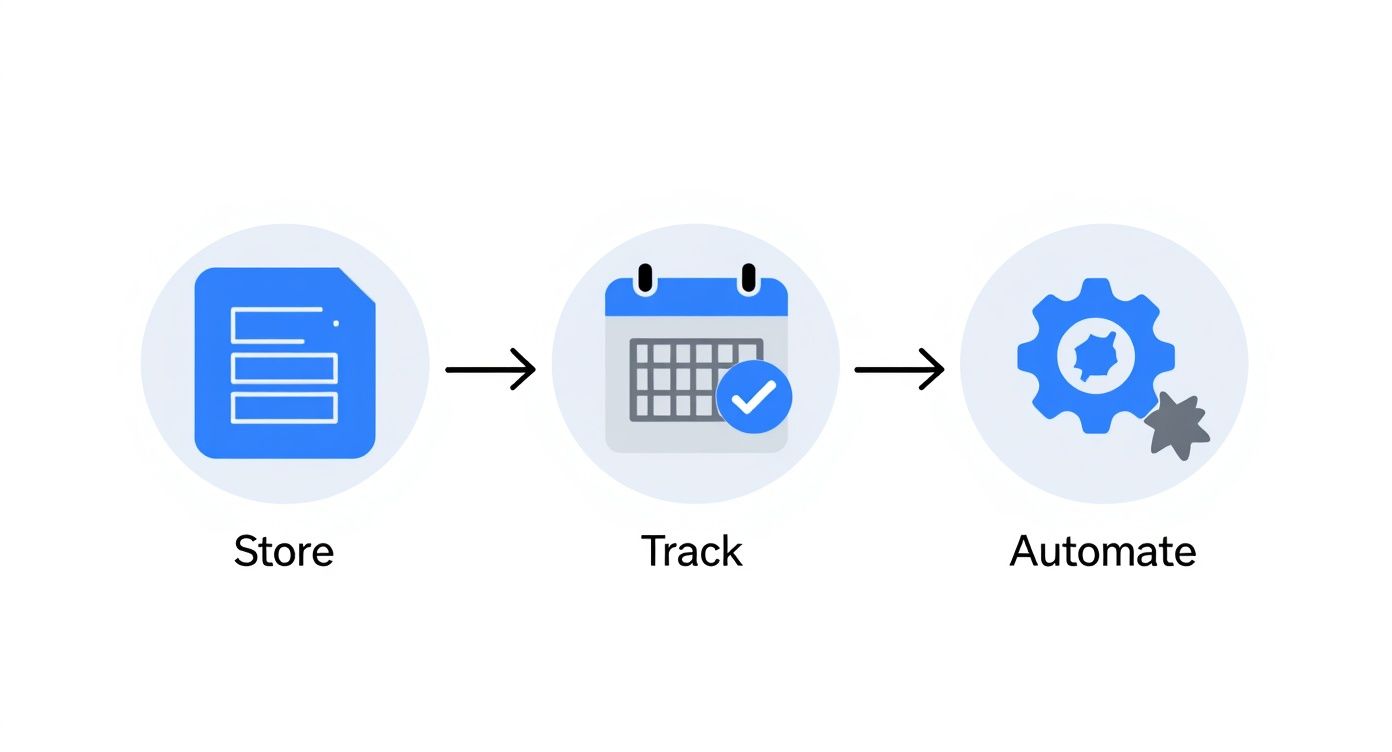
This store, track, and automate model is the foundation of modern contract management.
Bringing It All Together with BoloSign
We designed BoloSign to handle the complete contract lifecycle we’ve been discussing. It’s not just another tool for eSignature; it's a full-blown contract automation platform that gives your team the right tools at every single step.
- Creation and Drafting: Kick things off with smart templates that enforce consistency from the start. For a staffing agency, that means every new client agreement already has the correct fee structures and service levels baked in.
- Review and Negotiation: Our AI contract review flags risky clauses in real-time. No more version-control chaos—everyone collaborates on a single document, which gets you to approval that much faster.
- Execution: Send agreements out for signature seamlessly. Whether you need to sign PDFs online or add signature to Google Form, the whole process is fast, secure, and fully compliant with ESIGN and eIDAS standards.
- Post-Signature Management: Every executed contract lands in a secure, central repository with a complete audit trail. You can set up automated reminders for renewals and other key dates so you're always ahead of your obligations.
This isn't about just stitching tools together. It's an integrated flow that helps you close deals with more speed and a lot more confidence.
Smarter, Faster, and More Affordable
The real magic of a unified system is the efficiency it creates. For a healthcare provider, this translates to less time shuffling paperwork and more time focused on patients. For a real estate firm, it’s the difference between getting purchase agreements signed in minutes instead of days.
But that efficiency shouldn't cost a fortune. So many digital signing tools punish you for growing by charging per user or per document. We don’t.
We believe contract management should be accessible and predictable. That’s why we offer unlimited documents, unlimited templates, and unlimited team members for one simple, fixed price. This makes BoloSign up to 90% more affordable than alternatives like DocuSign or PandaDoc, without ever compromising on enterprise-grade security or compliance.
You get a powerful, AI-driven platform that manages everything from the first draft to the final digital signing solutions, all while keeping your costs completely predictable. You can get back to building your business instead of counting envelopes.
Ready to see how a truly unified workflow can change your contract process? Experience the speed, intelligence, and affordability of BoloSign for yourself. Start your 7-day free trial today and see how easy it can be to write, manage, and sign contracts the smarter way.

Paresh Deshmukh
Co-Founder, BoloForms
5 Dec, 2025
Take a Look at Our Featured Articles
These articles will guide you on how to simplify office work, boost your efficiency, and concentrate on expanding your business.

Compare the best AI contract review tools for 2025. See features, benefits, and practical tips to implement them at scale. Explore BoloSign’s unified solution.
Paresh Deshmukh
Co-Founder, BoloSign

Learn if clickwrap agreements are legally binding, how they work, and key best practices for enforceability.
Paresh Deshmukh
Co-Founder, BoloSign
Ready to streamline your contract management with AI?
Contact Sales
AI assistant to draft, review, and eSign contracts on autopilot for fastest growing companies.
Email: support@boloforms.com


Sales Inquiry
Available On


AI assistant to draft, review, and eSign contracts on autopilot for fastest growing companies.
Email: support@boloforms.com
Company
Solutions
Resources
Legal & Security
Sales Inquiry
Available On